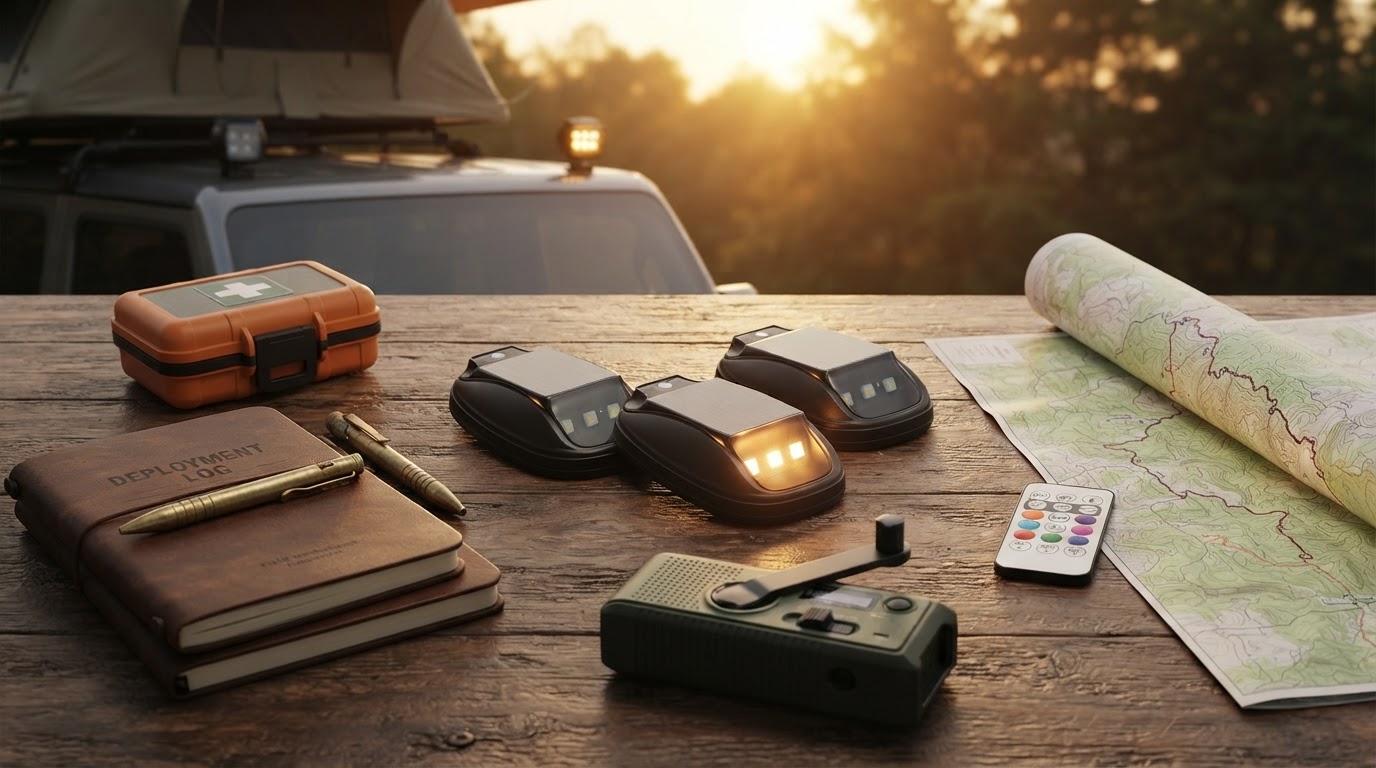
Solar Car Roof Light Deployment in Emergency Situations
 Maya ChenContributing Editor
August 3, 2026. This analysis examines the technical utility of solar-powered roof-mounted lighting systems during critical infrastructure failures. It is intended for emergency responders, fleet managers, and prepared consumers who require reliable signaling without reliance on a vehicle's primary battery.
The Failure of Grid-Dependent Emergency Signaling
The conventional wisdom says that a vehicle's standard hazard lights are sufficient for roadside emergencies or disaster response. Here's the part nobody talks about: a standard lead-acid car battery can be drained in as little as four to six hours of continuous hazard light operation if the engine is not running. In a flood, earthquake, or prolonged grid outage, idling an engine for light is not just fuel-inefficient; it is often impossible. According to EngoPlanet, solar-powered lighting solutions are becoming essential in disaster preparedness because they function autonomously when the central power grid fails, enhancing safety for rescue teams who must navigate darkened or debris-strewn environments. When the primary electrical system of a vehicle is compromised, a secondary, self-sustaining light source is the only viable method for maintaining visibility. Most consumers assume that a handheld flashlight is a suitable substitute, but static, roof-mounted illumination provides a 360-degree visibility profile that handheld devices cannot replicate. In high-stress recovery scenarios, the visibility of a stationary vehicle can be the difference between a successful extraction and a secondary collision. Relying on a system that draws from the same power source needed to start the engine is a fundamental design flaw in traditional automotive emergency kits.
Technical Integration of the Solar Car Roof Light
Photo by Deybson Mallony on Pexels
Run the math: a dedicated Solar Car Roof Light operates on a closed-loop system, utilizing high-efficiency photovoltaic cells to maintain a charge regardless of the vehicle's mechanical state. Research into consumer search patterns shows a growing demand for specific functionalities like the wireless solar strobe light for trucks and the solar anti-theft car warning light, indicating that users are moving away from wired, battery-dependent accessories. The Solar Car Roof Light addresses these needs by utilizing a wireless solar shark fin light design or a magnetic solar strobe mount, allowing for immediate deployment without drilling or complex wiring. These units are engineered to function as a solar car strobe light roof mount, providing the high-frequency flash patterns necessary for emergency signaling. Unlike internal cabin lights, the solar car roof light is positioned at the highest point of the vehicle, maximizing the line-of-sight for approaching emergency services or other drivers. The integration of vibration sensors in some models ensures that the light activates automatically upon sensing movement or impact, serving as a solar powered car anti-theft light during the night. Because these units are self-contained, they bypass the parasitic draw issues that plague traditional aftermarket strobe kits. This independence is critical; a solar car roof light ensures that even if a vehicle is abandoned or the battery is dead, the unit continues to signal its position for days using stored solar energy.
Strategic Selection and Deployment Framework
Choosing a solar-powered emergency light requires a shift from aesthetic preferences to rigorous performance standards. According to Bright Products, a high-quality solar lamp for emergencies must prioritize ease of mounting and light mode versatility to improve visibility for search teams. When evaluating a Solar Car Roof Light for a vehicle, the focus must remain on the durability of the solar interface and the lumen output of the LEDs. I'll change my mind about the necessity of these units when vehicle manufacturers begin integrating independent, solar-backed emergency circuits into standard chassis designs, but until then, aftermarket solar car roof lights remain the only redundant safety layer available. Users must verify that their chosen unit offers a high-intensity strobe mode, as static lighting is often ignored in high-traffic or low-visibility disaster zones. The mounting system—whether it is a magnetic solar strobe light for cars or a permanent adhesive shark fin—must be rated for high-speed wind resistance to ensure it remains attached during transit or extreme weather.
- Verify the presence of a multi-mode toggle (strobe, SOS, and constant-on).
- Confirm the inclusion of a high-capacity internal lithium battery for multi-night operation.
- Ensure the housing is IP65 rated or higher for moisture and dust resistance.
- Test the vibration sensor sensitivity to prevent false activations while parked in safe zones.
- Select a model with a low-profile aerodynamic shape to minimize drag and wind noise.
Shop Solar Car Roof Light here
Sources
- LuminAID Emergency Solar Lanterns
- Features of Solar Emergency Charging Light
- How to choose the best solar lamp for emergencies | BRIGHT